There’s a mouth in Proverbs 22:6. You won’t find it in your English Bible.
Here’s the verse in the ESV:
Train up a child in the way he should go,
even when he is old he will not depart from it.
The Hebrew behind that verse has nine words. We’ll focus on the first five words.

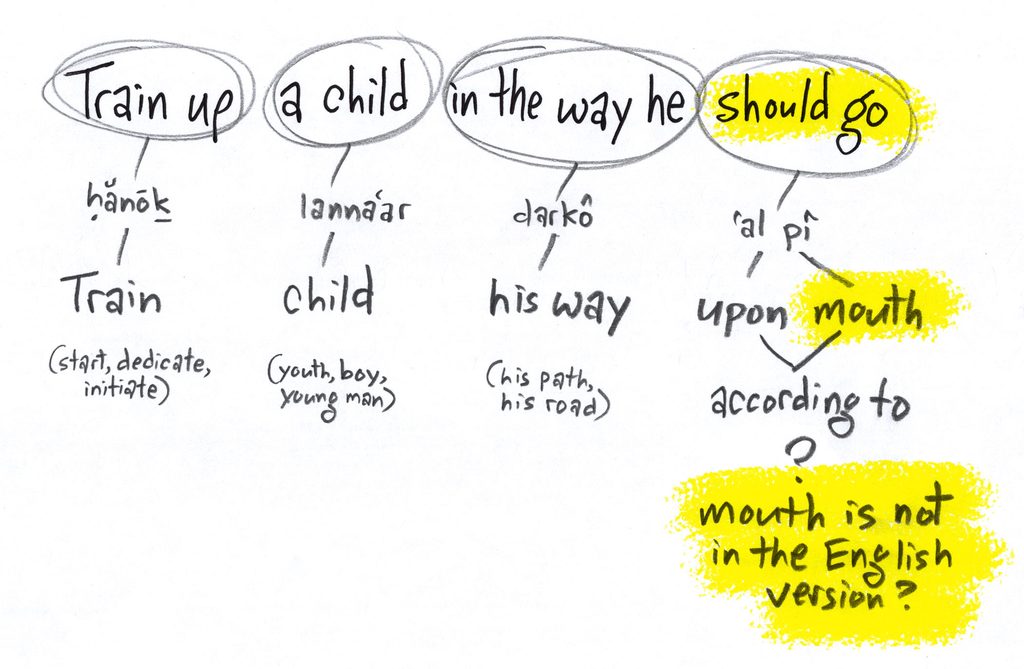
One of them is pî, the word for “mouth.” I really wanted to see where that mouth goes. So I lined up the Hebrew one word at a time.
Eight Hebrew words
חֲנֹךְ לַנַּעַר עַל־פִּי דַרְכּוֹ גַּם כִּי־יַזְקִין לֹא־יָסוּר מִמֶּנָּה
- ḥănōḵ: train, start, dedicate, initiate
- lannaʿar: the child, youth, boy, young man
- ʿal pî: according to, in accordance with, by the measure of
- ʿal: upon, over
- pî: mouth of
- darkô: his way, his path, his road
- gam kî: even when
- yazqîn: he grows old
- lō yāsûr: he will not turn aside
- mimmennāh: from it
It’s curious that “mouth” (pî) is in the Hebrew, but it doesn’t appear in the English translation. When you take ʿal pî together, it literally means something like “upon the mouth.” That sounds strange in English, but ʿal-pî is an established Hebrew expression meaning “according to.”
How in the world did we get “upon the mouth” meaning “according to”?
Think about how a king gave an order before paper was everywhere. He said it out loud. Somebody heard it. Then everybody did what came out of his mouth.
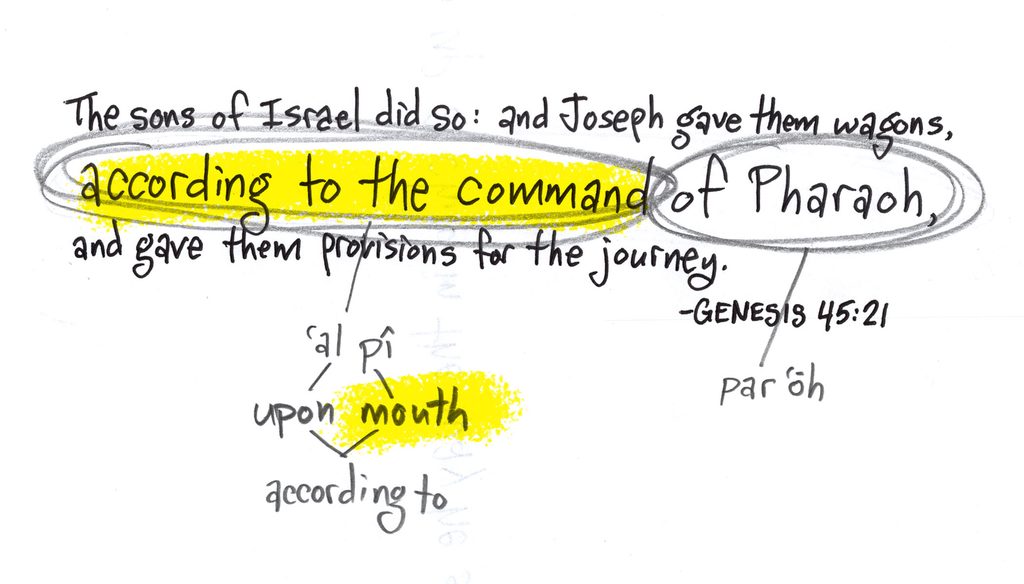
You can see the mouth doing that work in Genesis 45:21. Joseph gives his brothers wagons “according to the command of Pharaoh.” The Hebrew there is ʿal-pî parʿōh. Literally, “upon the mouth of Pharaoh.”

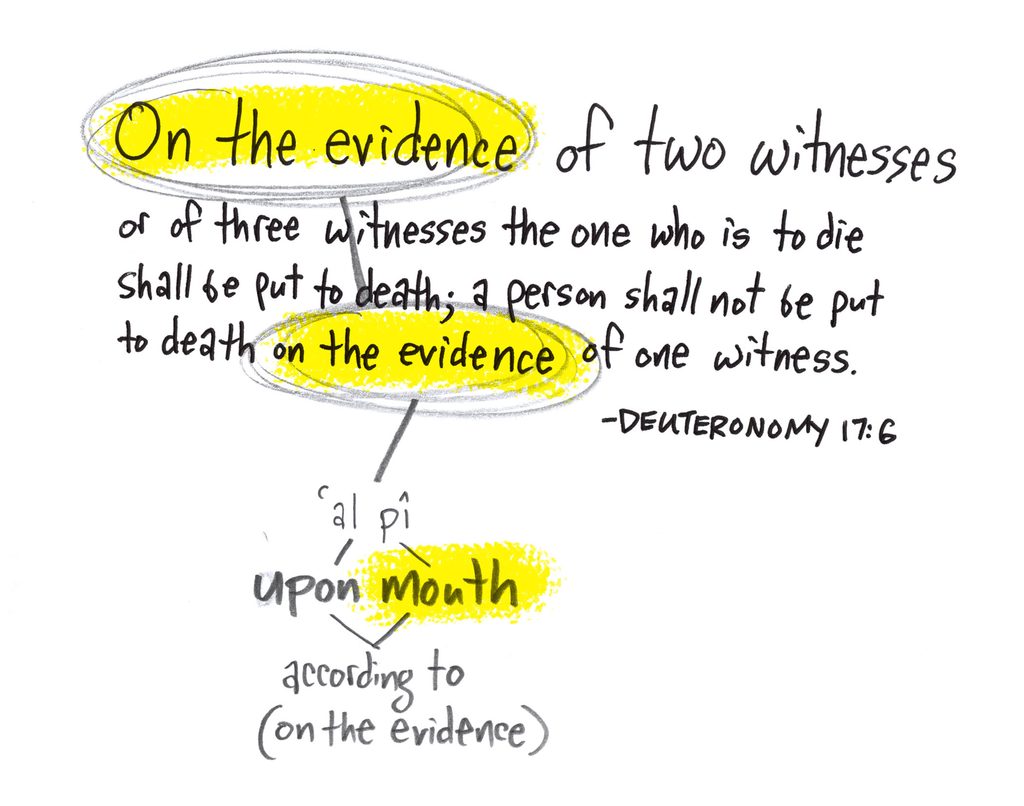
Courtrooms ran on mouths too. Deuteronomy 17:6 requires two or three witnesses before a death sentence. The Hebrew is ʿal-pî šənayim ʿēdîm (עַל־פִּי שְׁנַיִם עֵדִים). Upon the mouth of two witnesses. The case stood on what came out of their mouths.

Then the mouth goes all the way up. In Numbers 9:18, Israel set out and camped ʿal-pî YHWH. Upon the mouth of the LORD.
Later Hebrew kept stretching the phrase. Writers said ʿal pî ha-tôrâ, “according to the Torah.” Modern Hebrew says ʿal pî ha-ṭevaʿ, “according to nature.”
Nature doesn’t have a mouth. By then the phrase didn’t need one.
That explains how “upon the mouth” came to mean “according to.” But according to what? In this verse, it’s according to “his way.” A word-for-word reading goes something like this:
Train the youth upon the mouth of his way. Even when he grows old, he will not turn aside from it.
That puts the whole verse on one word. Whose way is “his way”?

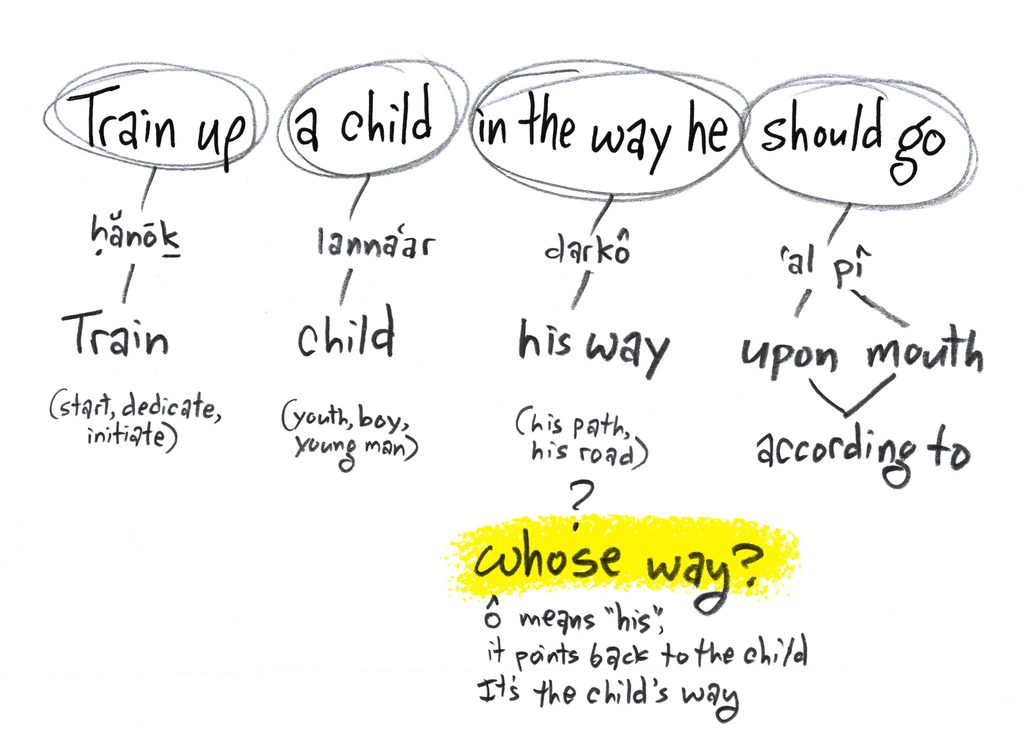
The little -ô on the end of darkô means “his.” It points back to the child. So it’s the child’s way. But what kind of way? I see three answers out there. One I’m confident in. One I enjoy pondering. One falls apart.
Interpretation 1: the way of wisdom
This is the interpretation behind “the way he should go.” The child is trained in the way of wisdom. When he’s old, he keeps walking it. I’m confident this is the main meaning.
Proverbs is a book about two paths. It says why it exists right at the start. It gives “knowledge and discretion to the youth” (Proverbs 1:4). That’s the same word, naʿar. Three verses later comes the foundation: “The fear of the LORD is the beginning of knowledge” (Proverbs 1:7).
From there the paths keep showing up. Proverbs 4:18–19 compares the path of the righteous to the light of dawn. The way of the wicked is like deep darkness. Psalm 1:6 says the LORD knows the way of the righteous, and the way of the wicked will perish.
Even the verse right before ours is about paths:

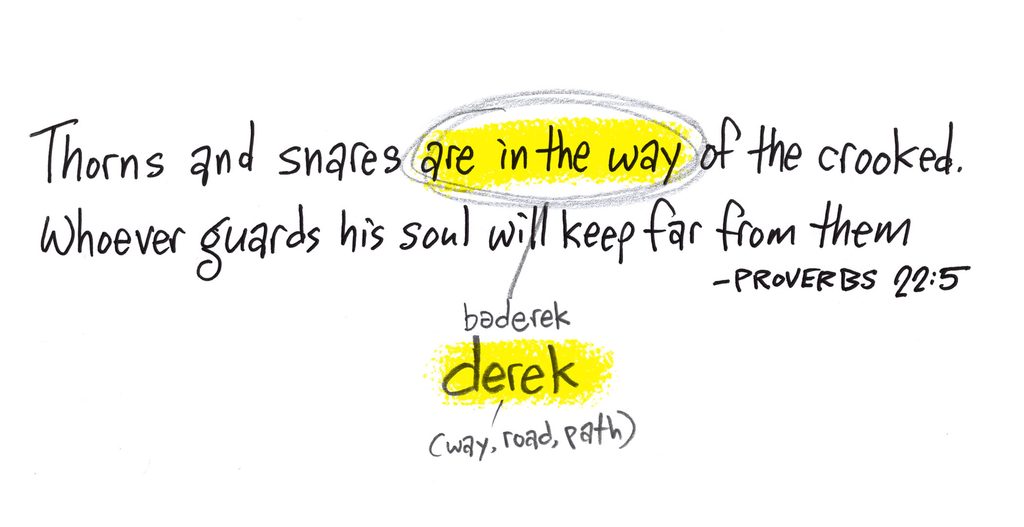
Same word, derek.
Nathaniel Erickson makes this case well in “Train up a child” and Proverbs 22:6: What is “the way he should go”? He quotes a commentator who points out that Proverbs only offers two ways. You walk with the wise and righteous, or you walk with the fool and the wicked. Only one of those is the way a child should go.
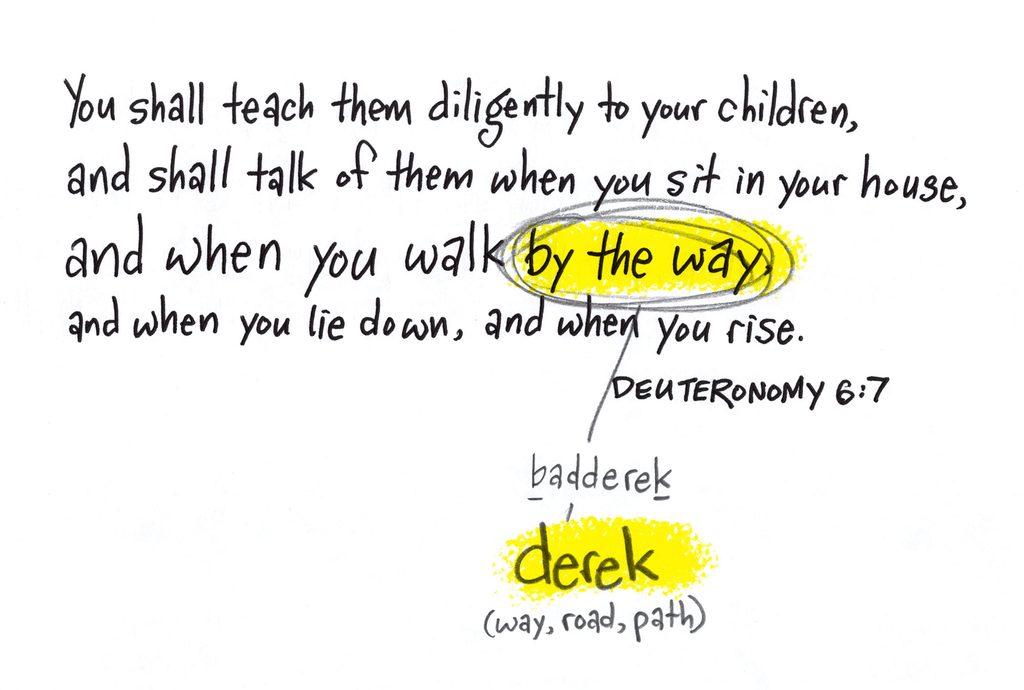
This reading fits the rest of Scripture on raising kids too. Moses tells parents to teach God’s words diligently to their children. Talk about them at home. Talk about them “when you walk by the way” (Deuteronomy 6:7). There’s derek again!

Paul tells fathers to bring their children up “in the discipline and instruction of the Lord” (Ephesians 6:4).
One caution that Erickson also makes. A proverb describes how life usually goes. He’s careful to say there are no guarantees here. Plenty of faithful parents have watched a child wander. The verse gives parents something to aim at, and it leaves the outcome in God’s hands.
Interpretation 2: the child’s own foolish way
Now for the interpretation I like to think about. What if “his way” means the way the child already wants to go? Then the verse reads like a warning. Train a kid according to his own foolish way, and when he’s old he won’t leave that way either.
I didn’t invent this. The medieval Jewish commentator Ralbag read the verse as satire along these lines. Let a child have his will, and he’ll stay in his bad way his whole life. Old Testament scholar Bruce Waltke noted that the grammar could support “Dedicate a youth according to his foolish way.”
Edward Wilde walks through both of them on his blog Memoir and Remains, in Proverbs 22:6: What Kind of Way? Wilde has taught biblical counseling and theology as an adjunct professor at The Master’s College. He also calls his blog more of a notebook than a finished treatise. I like that.
Why it could be
The word darkô says “his way.” The Hebrew has no word for “should.” Translators supply that idea because they understand the verse to mean the way the child ought to go. That is a reasonable interpretation in the context of Proverbs, but it is still an interpretation. The Hebrew itself leaves us with “his way,” without explicitly telling us what kind of way it is.
Proverbs has a lot to say about a child’s own way. Nine verses later we get this:
Folly is bound up in the heart of a child, but the rod of discipline drives it far from him. (Proverbs 22:15)
Proverbs 29:15 adds that a child left to himself brings shame to his mother.
The fool has a way of his own in Proverbs. “The way of a fool is right in his own eyes” (Proverbs 12:15). And Proverbs 14:12 warns about a way that seems right to a man, but its end is the way to death.
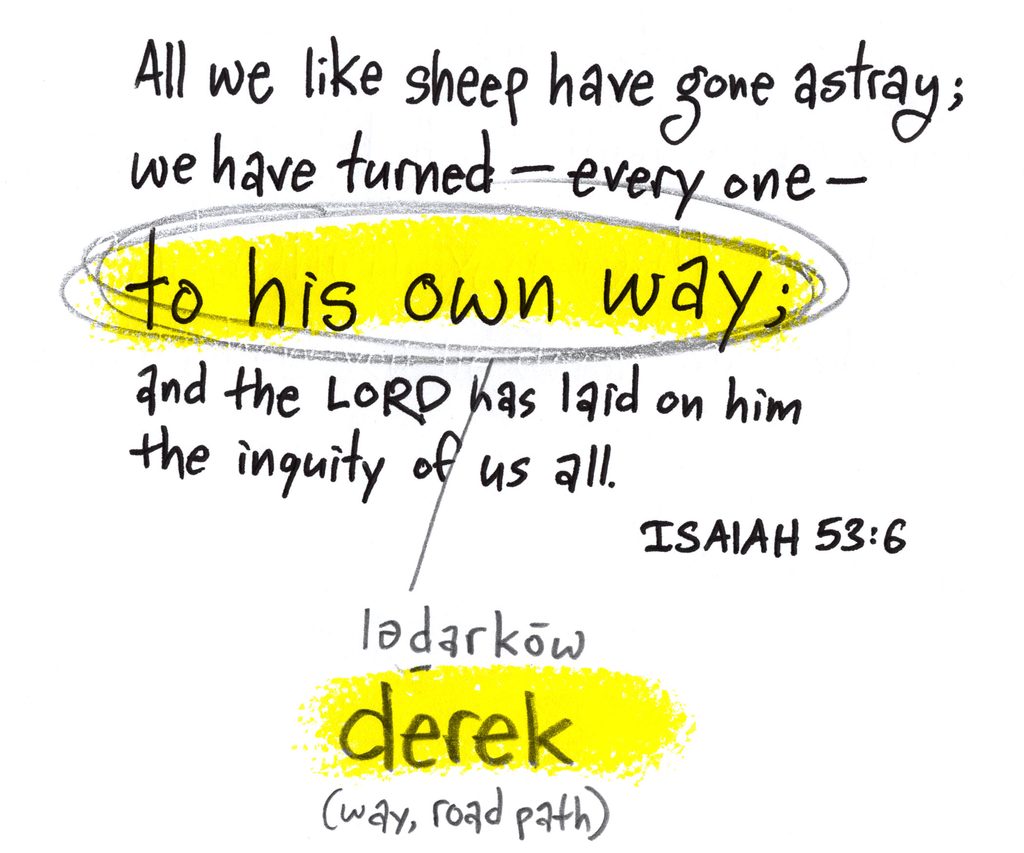
Isaiah uses this exact word. Isaiah 53:6 says we have all gone astray like sheep, each one turning to his own way. In Hebrew, “his own way” is darkô. Same word as Proverbs 22:6.

And Proverbs knows how to set two meanings side by side. Look at Proverbs 26:4–5:
Answer not a fool according to his folly, lest you be like him yourself. Answer a fool according to his folly, lest he be wise in his own eyes.
The same phrase, “according to his folly,” pulls in opposite directions two verses apart.
Why it might not be
The Hebrew never directly calls the child’s way foolish. That word could only be inferred by the reader. Does Proverbs ever imply a double-meaning? There is a double meaning in Proverbs 26:4-5. But that tension is obvious. Proverbs 22:6 gives no such clear signal.
As far as I can tell, the exact phrase ʿal-pî darkô shows up nowhere else in the Hebrew Bible. So there’s no second use to compare it against.
The verse opens with a command. Ḥănōḵ! Train! A command to train a kid in folly would have to be sarcasm. Waltke himself decided the sarcasm was too sharp and set this reading aside. (Wilde disagrees with him. He points out that an old fool with gray hair is still a fool.)
The old Greek translation, the Septuagint, doesn’t help either. It skips this verse entirely and goes from verse 5 to verse 7.
So I can’t say the author meant a double meaning. I still enjoy thinking about it. Either way, the verse says the path a child starts on tends to become the path he stays on.
Interpretation 3: the child’s personality
The third interpretation is popular in parenting books. “His way” means the child’s personality and natural bent. Figure out how your kid is wired, then train him along that grain.
Insight for Living makes this case in A Better Way to Train Up a Child. It points to Proverbs 30:18–19, where derek describes the way of an eagle in the sky and the way of a serpent on a rock. Those ways are each creature’s characteristic manner. So the article says to train a child according to his characteristic manner. It also brings in an Arabic custom where a midwife rubs crushed dates on a newborn’s palate, plus a picture of a horse and its bridle.
Skip Moen goes further in Not Quite What You Thought. He suggests ʿal-pî darkô could mean “according to the way he faces.” He connects the mouth to the face, and the face to the passion God built into the child.
The idea is older than modern psychology. The NET Bible notes say the Jewish scholar Saadia (882–942) first suggested training a child according to his inclination.
Knowing each child well is a wonderful idea. I just don’t want to write it into this verse. Here’s where it falls apart for me.
A mouth is a mouth. Pî means “mouth.” Hebrew has a separate word for “face,” pānîm. And ʿal-pî already has a job as the idiom for “according to.”
Arabic customs tell us about Arabic. The midwife and the dates make a lovely picture. A custom in a related language can’t decide what a Hebrew word meant in Proverbs. The horse and bridle are the article’s own illustration.
Proverbs 30 is about eagles and ships. When Proverbs talks about a person’s way, it’s almost always moral. And Proverbs is honest about what sits in a child’s natural bent: folly bound up in his heart (Proverbs 22:15).
Scripture keeps putting the steering somewhere else. “The heart of man plans his way, but the LORD establishes his steps” (Proverbs 16:9). Jeremiah admits that a man’s way is not in himself to direct (Jeremiah 10:23). In the days of the judges, everyone did what was right in his own eyes (Judges 21:25). That didn’t go well.
The Bible does care about each child as a person. God knit each one together (Psalm 139:13–14). Proverbs 20:11 even says a child shows who he is by what he does. Look at how that verse ends, though. It asks whether his conduct is pure and upright. Proverbs pays attention to the individual kid, and it still points him toward what’s right.
The NET note is pretty blunt about it. It says the verse doesn’t describe training a child according to his personality trait.
So which way is his way?
Interpretation one is the meaning I find most convincing. Train a child in the way of wisdom.
But even this reading involves interpretation. The Hebrew says “his way,” not explicitly “the way he should go.” We infer the positive meaning from the command to train and from Proverbs’ larger teaching about wisdom and folly.
Interpretation two is something I can’t directly prove. I infer “foolish” where the Hebrew doesn’t say it. But I enjoy contemplating the possibility. The same training that sets a child on the good road could set him on his own road if a parent simply lets him go.
Interpretation three is good parenting advice from somewhere else in life.
I went looking for a mouth in this verse. It was tucked inside “according to” the whole time.
When you read Proverbs 22:6, do you hear the warning too?